
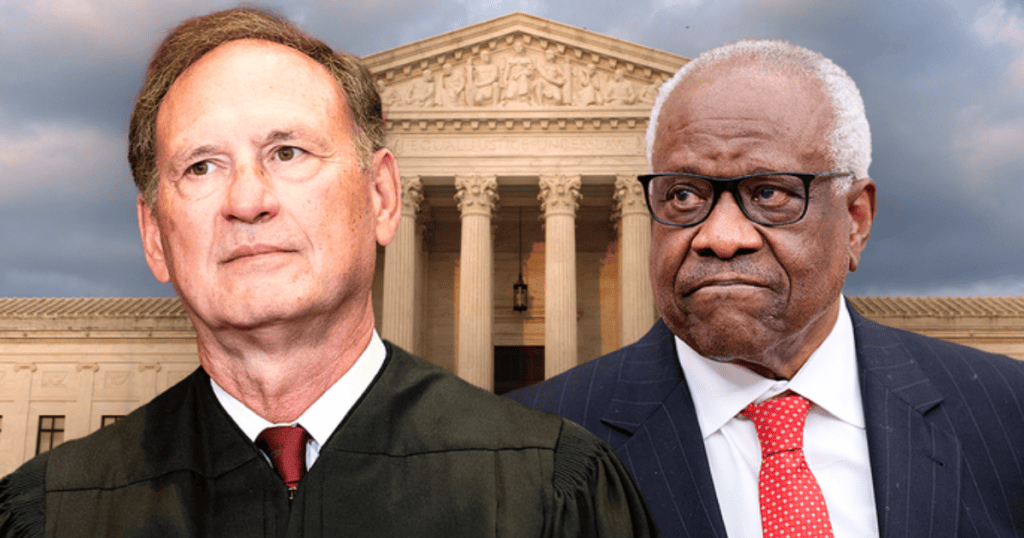
Supreme Court blocks Trump’s mail ballot rule before the 2026 midterms as Justices Alito and Thomas sharply dissent over USPS authority.
The Supreme Court has rejected the Trump administration’s request to revive new federal rules governing election mail, leaving a lower-court injunction in place ahead of the 2026 midterm elections.
Justices Samuel Alito and Clarence Thomas sharply dissented, arguing that the federal government had a strong case for allowing the U.S. Postal Service to implement the new ballot-mail requirements.
Supreme Court rejects emergency request
The court denied the administration’s application for a stay in a brief order issued Monday.
The majority concluded that the government was unlikely to succeed on the merits of its challenge and that the circumstances did not justify emergency relief.
The decision keeps a lower-court injunction blocking the USPS rule in effect. The rule had been designed to establish new requirements for federal election ballot mail, including specific envelope features and information that states would provide to the Postal Service.
Alito calls challenge a “Hail Mary pass”
Alito, joined by Thomas, took a dramatically different view of the case.
In his dissent, Alito argued that some of the organizations challenging the rule lacked legal standing and that the states were relying on an unusually difficult legal theory.
He described the states’ argument as a “Hail Mary pass” that rarely succeeds, citing an earlier Supreme Court decision.
Alito argued that the Postal Service has broad authority under federal law to regulate the collection, handling, transportation, delivery and return of mail.
He maintained that the new election-mail requirements did not clearly exceed that authority.
What the USPS ballot rule would require
The Postal Service finalized the rule in late August following President Donald Trump’s directive concerning federal election mail.
Under the regulation, federal ballot mail would have to use envelopes with specific features, including an election-mail logo, compatibility with high-speed scanning equipment and a unique barcode.
States would also have been required to submit basic information about voters to a Postal Service portal. Noncompliant mailings could be returned to the states for correction.
The administration argued that the changes would strengthen oversight of federal ballot mail and improve election integrity.
Opponents argued that implementing the requirements so close to the midterms could disrupt existing election systems and potentially affect voters.
Kavanaugh takes different position
Justice Brett Kavanaugh provided a separate concurrence that added an important distinction to the ruling.
Kavanaugh indicated that there was at least a possibility that the Postal Service had statutory authority to adopt the rule. However, he concluded that putting the requirements into effect for the 2026 elections would be unlawful because state and local election officials did not have enough time to implement them properly.
That reasoning differs from simply declaring that the Postal Service could never impose such requirements.
Decision deals setback to Trump ballot push
The ruling represents a setback for Trump’s effort to change the federal government’s role in handling election mail before the November midterms.
Reuters reported that the administration’s rule was intended to require states to provide voter lists and use USPS-approved envelopes with barcodes. States and voting-rights groups challenged the changes, arguing that they could interfere with legitimate mail ballots and intrude on state authority over elections.
The Supreme Court’s decision means states can continue using their existing mail-ballot procedures for the upcoming elections while the legal dispute continues.
Alito and Thomas warn of broader implications
The dissent from Alito and Thomas highlights a larger constitutional and legal dispute over federal authority in elections.
The justices argued that Congress gave the Postal Service broad powers to regulate mail and that the challengers had not shown that the agency’s rule was clearly outside those powers.
The majority, however, declined to lift the injunction at this stage.
The split illustrates the continuing disagreement at the Supreme Court over how aggressively federal agencies can exercise authority when their actions intersect with state-administered elections.
Mail voting remains a major election issue
The case comes as mail voting remains a major political issue ahead of the 2026 midterms.
Trump and his allies have repeatedly questioned the security of mail-in voting, while Democrats and voting-rights organizations have generally defended it as an important option for voters.
The Supreme Court’s ruling does not resolve every underlying question surrounding the USPS rule. Instead, it determines that the administration has not shown enough to justify lifting the lower-court injunction before the 2026 elections.
For now, the existing mail-ballot systems remain in place, while Alito and Thomas have made clear that they believe the court should have taken a different path.


