
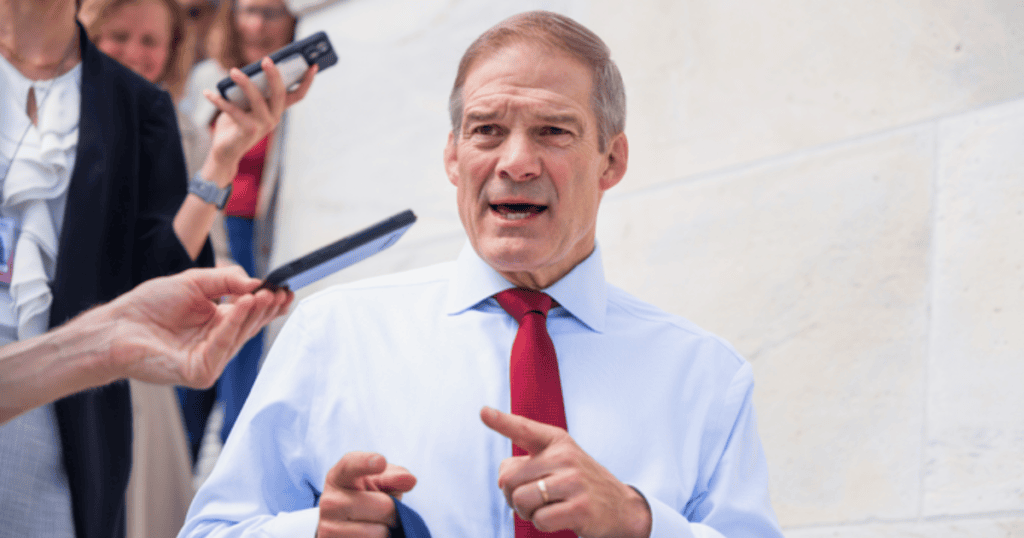
Jim Jordan subpoenas DAs in Boulder and Fairfax over alleged sanctuary policies, demanding records as Congress expands its immigration oversight.
House Judiciary Committee Chairman Jim Jordan is escalating a congressional investigation into sanctuary jurisdictions, issuing subpoenas to prosecutors in Boulder County, Colorado, and Fairfax County, Virginia, over their offices’ handling of cases involving non-U.S. citizens.
The subpoenas mark a new phase in a months-long inquiry that has increasingly focused on the intersection of local criminal prosecution and federal immigration enforcement.
Jordan, an Ohio Republican, is seeking documents and communications from Boulder County District Attorney Michael Dougherty and Fairfax County Commonwealth’s Attorney Steve Descano. According to Fox News Digital, the committee gave both prosecutors until Sept. 25 to comply.
The dispute is not simply about paperwork. At its heart is a larger question: How much room do local prosecutors have to shape criminal cases when federal immigration consequences may follow?
Jordan turns requests into subpoenas
The House Judiciary Committee had previously sought information from the two offices. Jordan said the prosecutors had not produced the requested documents, prompting the committee to use compulsory process.
In letters obtained by Fox News Digital, Jordan accused the offices of providing what his committee describes as “preferential treatment” to foreign nationals accused of crimes. Those are allegations from the committee, not judicial findings.
The move follows similar congressional inquiries involving prosecutors and law-enforcement officials in other jurisdictions.
In July, Jordan subpoenaed Philadelphia District Attorney Larry Krasner for information concerning Philadelphia’s sanctuary policies after the committee said his office had failed to provide requested material.
In August, Jordan and Rep. Tom McClintock, a California Republican who chairs the Judiciary Committee’s immigration enforcement subcommittee, renewed requests to Fairfax County’s Steve Descano and Queens District Attorney Melinda Katz.
The pattern is clear: congressional investigators are moving from letters and requests toward subpoenas when local officials do not provide the information being sought.
What is Jordan investigating?
The investigation centers on policies that prosecutors use when handling criminal cases involving people who may face immigration consequences.
According to Fox News Digital, Descano’s office issued plea-bargaining guidance in 2020 instructing prosecutors to consider immigration consequences where possible and examine the collateral immigration consequences associated with particular charges.
That policy has become a central point of disagreement.
Jordan’s committee argues that considering immigration consequences can result in defendants receiving different treatment based on immigration status. Critics of the congressional investigation, however, have argued that the inquiry improperly mixes federal immigration enforcement with the responsibilities of state and local prosecutors.
Boulder District Attorney Michael Dougherty has described Jordan’s investigation as “political theater,” according to a May report cited by Fox News Digital. Dougherty argued that the inquiry overlooks what he characterized as failures in the federal immigration system.
That disagreement matters because the subpoenas are not themselves proof that either prosecutor violated federal law.
They are an investigative tool.
Sanctuary policies at the center of the dispute
Boulder and Fairfax County are identified as sanctuary jurisdictions, where local authorities have policies limiting cooperation with federal immigration enforcement. Fox News Digital reported that Boulder’s government adopted an ordinance in 2017 directing government employees not to cooperate with federal immigration authorities or inquire into a person’s immigration status.
Supporters of such policies generally frame them around local law-enforcement priorities and the relationship between police, prosecutors and immigrant communities. Federal officials and congressional Republicans investigating the policies have raised a different concern: whether local restrictions can interfere with federal immigration responsibilities.
That tension has existed for years, but the current congressional investigation is putting fresh pressure on individual prosecutors.
And that could make the next few weeks significant.
The legal question behind the political fight
Jordan’s committee has argued that Congress has authority to investigate sanctuary policies because immigration is principally a federal responsibility. The committee has made similar arguments in its investigation of Philadelphia’s district attorney.
But congressional oversight and criminal liability are two different things.
A subpoena demands information. It does not establish that a prosecutor committed a crime or violated federal law.
Whether the requested records are ultimately produced, challenged or litigated could determine how far the investigation proceeds.
That is where the story gets more complicated than the political headlines suggest.
State and local prosecutors operate within their own criminal-justice systems, while immigration enforcement is principally handled by the federal government. When those responsibilities overlap, disputes can quickly become constitutional and legal questions rather than merely policy disagreements.
A widening congressional campaign
Jordan’s latest subpoenas fit into a broader House Judiciary Committee effort examining sanctuary policies around the country.
The committee has sought information from officials in jurisdictions including New York City and Boston, while also opening inquiries involving California jurisdictions such as San Francisco and San Diego.
The Philadelphia subpoena demonstrated that the committee was willing to escalate after unsuccessful document requests. The Boulder and Fairfax subpoenas now extend that strategy.
For the prosecutors involved, the immediate issue is straightforward: respond to the congressional demands or contest them.
For Congress, the larger objective is determining what local sanctuary policies actually do in practice and whether those policies conflict with federal interests.
The Sept. 25 deadline puts a date on the next stage of that confrontation.
Until then, the central dispute remains unresolved: where federal immigration authority ends and local prosecutorial discretion begins.


