NTSB data shows an Amazon cargo jet’s speed brakes and thrust reversers did not deploy before the deadly Miami runway crash that killed five.
MIAMI — Investigators have uncovered a critical new detail in the deadly Amazon cargo jet crash at Miami International Airport, revealing that two key systems designed to slow the aircraft were not deployed before it overran the runway.
The National Transportation Safety Board said Tuesday that flight data from the Boeing 767 showed the aircraft’s wheel brakes were applied, but there was no indication that its speed brakes or thrust reversers were activated during the landing.
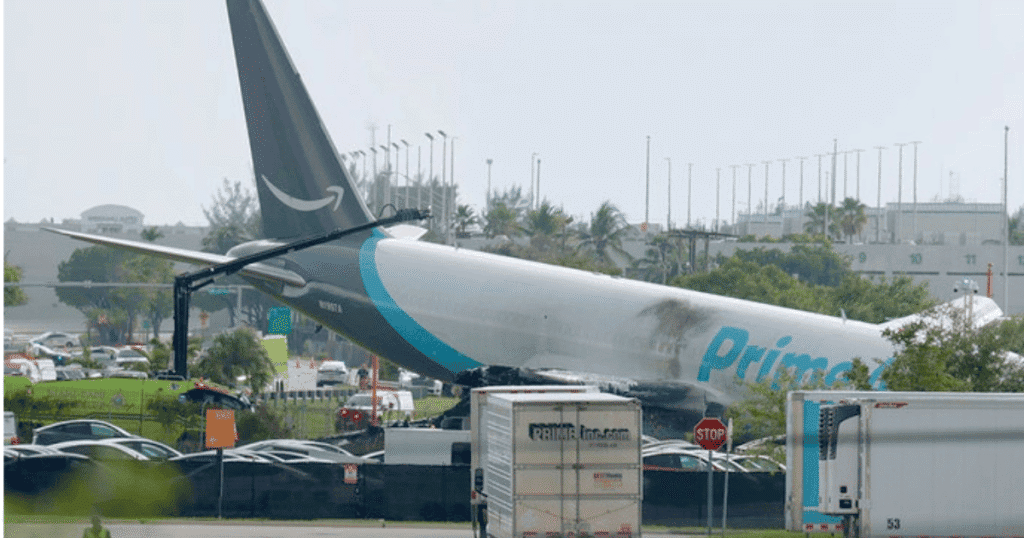
The Amazon Prime Air jet, operated by 21 Air, crashed Sunday after running off the end of a runway at Miami International Airport. The aircraft struck multiple vehicles, killing five people and injuring five others.
Key braking systems were not deployed
NTSB investigators said the available flight data showed no evidence that the aircraft’s speed brakes or thrust reversers were deployed.
Those systems are designed to help an aircraft rapidly reduce speed after touchdown. The wheel brakes were applied, according to investigators, but the new finding raises questions about what happened during the critical seconds after the Boeing 767 landed.
NTSB investigator Chihoon Shin cautioned against drawing conclusions before investigators have analyzed the full set of flight parameters and interviewed the pilots. Officials have not yet determined whether the systems failed mechanically, were not activated by the crew or were affected by other circumstances.
Investigators are expected to question the two pilots as the probe continues. Both survived the crash and were hospitalized following the accident.
Pilots appeared to attempt a go-around
Flight data has also provided investigators with a closer look at the pilots’ actions immediately after touchdown.
The Boeing 767 landed at a high speed and then increased engine power, suggesting the crew may have attempted to abort the landing and perform a go-around.
The attempt was not completed. The throttles were subsequently reduced and the aircraft’s brakes were reapplied as the jet continued down the runway.
The sequence is now a major focus of the NTSB investigation, although officials have emphasized that it is too early to determine why the crew made those decisions or whether the aircraft was already unable to stop safely.
Five people killed in runway overrun
The crash occurred Sunday when the Amazon cargo aircraft overran the runway at Miami International Airport.
After leaving the runway, the jet broke through the airport perimeter fence and struck vehicles outside the runway area. Five people inside a van were killed, while additional people were injured. The aircraft eventually came to rest roughly 1,300 feet beyond the runway.
The flight was carrying more than 32,000 pounds of cargo, primarily contact lenses, according to the NTSB. Officials said there were no hazardous materials aboard.
The aircraft was a Boeing 767 that had been converted from passenger service to a cargo configuration. Investigators are examining its mechanical condition, the landing sequence, weather conditions and the decisions made by the flight crew.
Investigation remains ongoing
NTSB officials have stressed that the latest findings do not establish the cause of the crash.
Investigators are still reviewing the aircraft’s flight-data and cockpit-voice recordings, examining the wreckage and gathering information about the weather and runway conditions.
The agency also plans to interview the pilots to establish what they saw, what actions they took and why the landing developed into a runway overrun.
The investigation could take months, and officials have warned against assigning blame before all the evidence has been examined.
For now, the discovery that the Amazon jet’s speed brakes and thrust reversers were not deployed provides investigators with another crucial piece of evidence as they work to determine why the aircraft could not stop before reaching the end of the Miami runway.
Also read: Trump-Backed Candidate Wins Key New Hampshire Primary
Satta Matka 16