
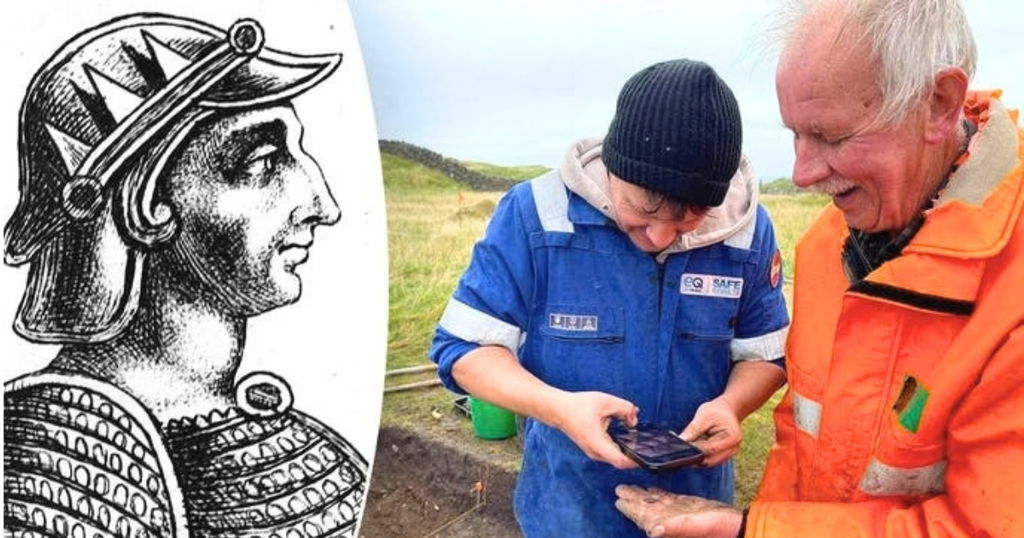
Mysterious 1,000-Year-Old Coin Reveals King’s Past found in Scotland offers clues about Æthelred the Unready and ancient coastal links in a striking new find!
Mysterious 1,000-Year-Old Coin Reveals King’s Past
A mysterious 1,000-year-old coin bearing King Æthelred the Unready’s face has emerged in Scotland, offering a remarkable glimpse into medieval history.
Archaeologists uncovered the rare Anglo-Saxon penny during an excavation in Nesting, a coastal community in Scotland’s Shetland Islands. The discovery could reveal important clues about historic connections between Scotland and Anglo-Saxon England.
Experts believe the coin dates between 991 and 997 AD. Its surviving markings and royal portrait make it an especially intriguing archaeological find.
Rare Anglo-Saxon Coin Unearthed in Scotland
The excavation originally focused on prehistoric structures threatened by coastal erosion. However, the team also uncovered evidence from later periods, highlighting the area’s remarkably rich history.
The coin carries the image of Æthelred II, an English king whose troubled reign coincided with repeated Viking attacks. Despite its age, some of the artifact’s original details remain visible beneath a thick, greenish-brown patina.
Archaeologist Elinor Graham of the University of Aberdeen participated in the excavation while visiting Shetland. She described the discovery as an unusually exciting moment during her holiday.
Why the Coin’s Condition Matters
The coin’s surviving inscriptions provide valuable evidence for specialists studying early medieval currency. Its details may help researchers understand how people produced, circulated, and handled money more than a millennium ago.
Graham reportedly noted that the lettering remained remarkably sharp. The team quickly recognized the coin’s rarity and significance within the archaeological context.
Although the artifact looks weathered, its remaining features preserve clues about its original appearance. Careful examination could help specialists learn more without damaging the fragile object.
Who Was King Æthelred the Unready?
Æthelred II ruled England from 978 to 1013 AD before briefly losing his throne. He returned in 1014 and remained king until his death in 1016.
History remembers him as Æthelred the Unready, a nickname that can create a misleading impression. The name derives from an Old English expression associated with poor advice or ill-considered decisions.
His reign faced persistent Viking raids and growing political instability. English authorities struggled to defend the kingdom against Scandinavian forces, including invasions led by Danish ruler Sweyn Forkbeard.
A King Shaped by Viking Attacks
Æthelred attempted to protect his kingdom through military resistance and payments to Viking forces. These payments, commonly called Danegeld, aimed to discourage further attacks.
However, such strategies failed to secure lasting peace. Sweyn Forkbeard drove Æthelred from England in 1013, although the English king later regained power.
The newly discovered coin offers a tangible connection to this turbulent period. It also highlights how royal currency carried political authority across territories and communities.
What Does the Discovery Reveal About Ancient Connections?
The coin’s discovery in Shetland raises intriguing questions about how it reached the islands. Its presence suggests possible connections between the region and the wider Anglo-Saxon world.
Shetland occupies a strategic position between mainland Scotland and Scandinavia. Across centuries, people travelled through these waters for trade, settlement, warfare, and cultural exchange.
Nevertheless, one coin cannot establish exactly who carried it or how it arrived. Researchers would need additional archaeological evidence to determine its journey with greater confidence.
Shetland’s Layers of History
The excavation area contains evidence spanning several historical periods, from prehistoric communities to later societies. This layered record makes the location especially valuable for archaeological research.
Coastal erosion also creates urgency for investigators seeking to document vulnerable sites. Excavations can preserve important information before natural processes damage or destroy archaeological remains.
The discovery adds another piece to Shetland’s complex historical record. Further study may help researchers connect the coin with broader patterns of movement and exchange.
Why This Ancient Coin Matters Today
Small objects can reveal significant details about the past. Coins, in particular, help researchers investigate rulers, economic systems, artistic traditions, and connections between distant communities.
This Anglo-Saxon penny links modern researchers with a king whose reign unfolded during a period of major upheaval. Its discovery also demonstrates how archaeological investigations can uncover unexpected evidence beyond their original goals.
The coin does not solve every mystery surrounding Æthelred’s reign or Shetland’s early medieval history. Yet its survival offers researchers a valuable opportunity to investigate those questions.
Ultimately, the remarkable find brings a distant period into sharper focus. As specialists examine its details, this mysterious 1,000-year-old coin may reveal more about the people and connections that shaped Britain’s past.
Also read: Michael Douglas Reveals Shocking Hollywood Bite Story








