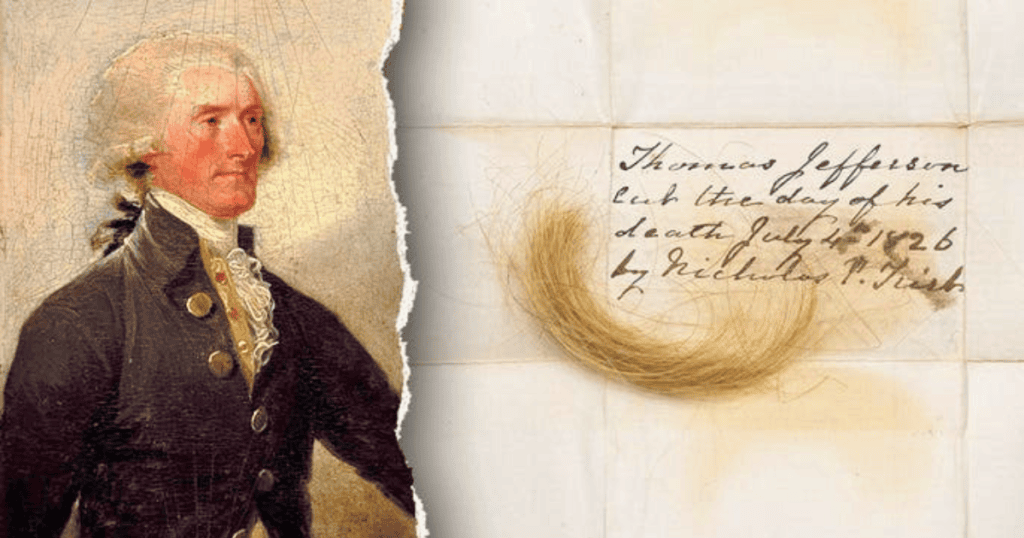
Strands of hair linked to Thomas Jefferson yield new DNA evidence, reinforcing conclusions about his children with Sally Hemings.
DNA From Thomas Jefferson’s Hair Settles Historic Debate
A centuries-old question surrounding America’s third president has reached a definitive milestone. Advanced genomic sequencing on strands of hair linked to Thomas Jefferson has delivered compelling new evidence regarding his relationship with Sally Hemings, an enslaved woman at his Monticello estate.
The breakthrough offers fresh clarity on one of the most long-standing paternity debates in American history, solidifying what scholars and historians have increasingly maintained for decades.
How Hair Strands Unlocked Genetic Secrets
The recent scientific inquiry center on strands of hair discovered tucked between the pages of an unpublished historical manuscript tied to Jefferson. Modern geneticists utilized cutting-edge genomic sequencing techniques to extract and analyze DNA directly from these preserved hair samples.
Researchers then constructed complex statistical models to evaluate competing paternity hypotheses involving:
- Thomas Jefferson himself
- His brother, Randolph Jefferson
- Randolph’s sons and other male relatives
The results were overwhelming. The statistical modeling revealed that the odds of Thomas Jefferson not being the biological father of Hemings’ sons, Madison and Eston Hemings, were less than one in a thousand. This overwhelmingly rules out alternative family theories—such as his brother Randolph being the father—and firmly points to the nation’s third president.
Reinforcing the Historical Record
Historians and stewards of Monticello view the new genetic data not as a rewrite of history, but as an ironclad confirmation. While a landmark 1998 Y-chromosome study first established a genetic link between the Jefferson male line and Hemings’ descendants, skeptics continued to point to male relatives as alternative candidates.
A Story of Resilience and Agency
Beyond resolving historical lineage, experts point out that the findings bring much-needed focus back to Sally Hemings. Living under the constraints of enslavement at Monticello while navigating a relationship with one of the nation’s most powerful men, Hemings negotiated freedom for her children, ensuring they could build lives beyond bondage.
The new DNA evidence serves as a reminder of how science and historical inquiry can work together, uncovering human truths buried deep within the founding era.
Also read: Why Quitting Vapes Is Driving People Back to Cigarettes