
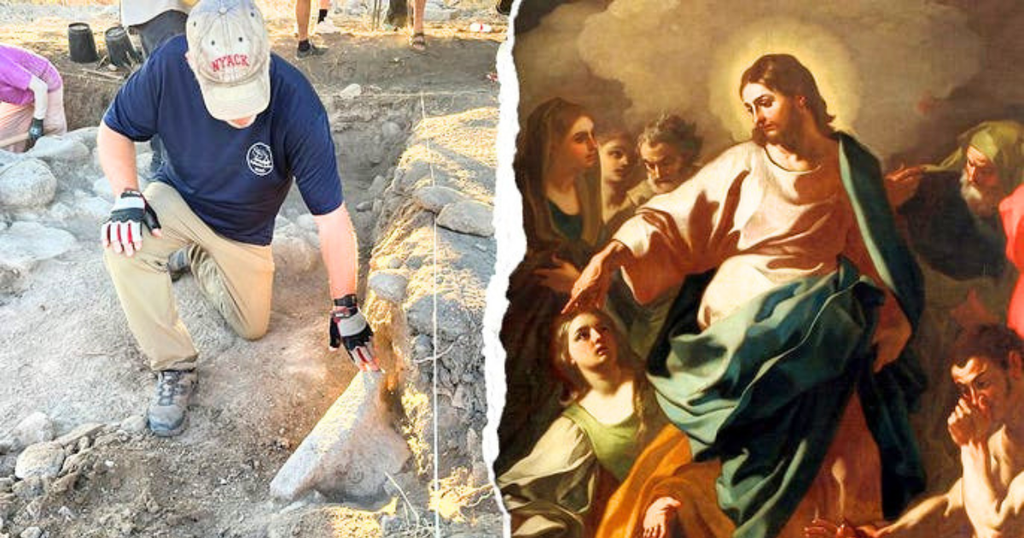
Archaeologists say El-Araj near the Sea of Galilee is biblical Bethsaida, the city linked to Jesus, his apostles and many miracles in the Gospels too.
A decades-old biblical mystery may have moved closer to a solution after archaeologists identified an ancient settlement near the Sea of Galilee as Bethsaida, the city associated with Jesus Christ and several of his miracles.
Researchers working at the archaeological site of El-Araj say a decade of excavations has produced mounting evidence that the ruins correspond to the Bethsaida described in the New Testament.
Steven Notley, a biblical scholar and academic director of the El-Araj Excavation Project, told Fox News Digital that he is now “100%” confident the site is Bethsaida. The excavation project, led by Mordechai Aviam, has been investigating the location since 2016.
Why Bethsaida matters in the Bible
Bethsaida holds an important place in the Gospel accounts. According to the New Testament, the settlement was associated with apostles Peter, Andrew and Philip and was located near the area where Jesus carried out much of his ministry.
The Gospels also connect the area with several miracles attributed to Jesus, including the healing of a blind man. The feeding of the 5,000 is likewise described as taking place near Bethsaida.
That biblical connection has made the search for the ancient city a major focus for archaeologists and biblical historians.
What archaeologists found at El-Araj
The evidence at El-Araj includes remains of an ancient Jewish fishing settlement as well as signs of later Roman-era urban development.
Among the discoveries are thousands of lead fishing weights, stone vessels associated with Jewish communities and the remains of a Roman bathhouse. Researchers have also recovered coins and pottery that are helping them reconstruct the history of the settlement.
For Notley, the combination is particularly significant because Bethsaida was expected to show evidence of both a Jewish fishing community and a more developed urban settlement.
Rather than pointing to one spectacular artifact as proof, the excavation team argues that the identification rests on the cumulative evidence gathered over successive seasons.
“Since 2016,” Notley said, researchers have not found anything that would challenge the identification, according to Fox News. Instead, he said, the evidence has become progressively stronger.
A discovery built over a decade
The El-Araj excavation has taken place over roughly ten years, making the latest claim the result of an extended archaeological investigation rather than a single discovery.
Researchers have continued to expose new sections of the settlement, revealing additional Roman-period structures and artifacts. The findings are helping scholars understand how the community developed during the period associated with the New Testament.
Still, the identification of ancient sites can remain a matter of scholarly debate. In this case, the strongest claim comes from the excavation project’s academic director, whose confidence is based on the accumulation of archaeological evidence at El-Araj.
If the identification is ultimately accepted broadly by scholars, Bethsaida would provide another important archaeological window into the world in which Jesus and his apostles lived and preached.
For now, El-Araj is emerging as one of the most closely watched archaeological sites connected to the historical landscape of the Gospels.
Also read: Engineer killed in random Texas park bench stabbing


