
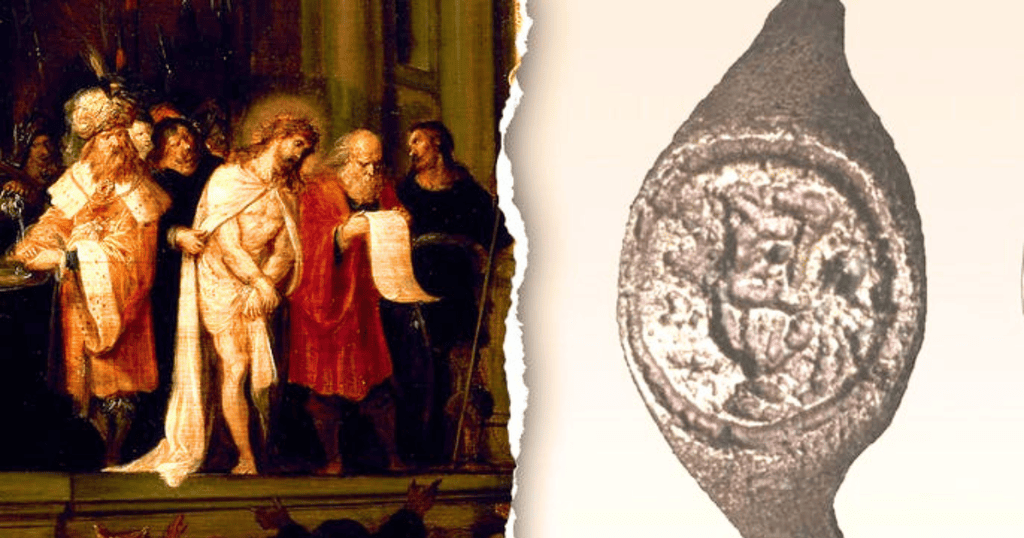
An ancient ring linked to Pontius Pilate is being reinterpreted, offering fresh clues about Roman authority and the biblical account of Jesus’ crucifixion.
A nearly 2,000-year-old ring once believed to have a possible connection to Pontius Pilate is getting a fresh interpretation that could shed new light on the Roman administration surrounding the crucifixion of Jesus.
The ancient ring was discovered decades ago at Herodium, a mountaintop fortress in the Judean desert. Although researchers first examined the artifact years later, a new study argues that its inscription may reveal more about how Pilate’s authority was delegated than about the Roman governor himself.
Ancient ring linked to Pontius Pilate
The copper-alloy ring was uncovered during archaeological excavations at Herodium in the 1960s. It remained in storage for more than five decades before researchers published detailed findings about it in 2018.
The ring features an image of a wine vessel and an inscription connected to the name “Pilatus.” That discovery initially raised the possibility that the object belonged to Pontius Pilate, the Roman prefect of Judea associated with the trial and crucifixion of Jesus.
However, archaeologists have long questioned whether the inexpensive ring could actually have belonged to a powerful Roman governor.
New study challenges old interpretation
Catherine Bonesho, a UCLA professor of ancient Judaism, has offered a new interpretation of the inscription in research published in Palestine Exploration Quarterly.
Bonesho argues that the wording represents a transliteration of the Latin PILATO into Greek letters. Rather than meaning the ring personally belonged to Pilate, the wording could indicate something associated with Pilate or performed on his behalf.
The distinction could significantly change how historians understand the artifact.
Instead of being a personal possession of the Roman governor, the ring may have been used by someone working within his administration.
Ring may reveal how Pilate delegated power
Historian Candida Moss told Fox News Digital that the reinterpretation could help explain why the ring appears relatively inexpensive.
A governor overseeing Roman Judea would not necessarily be expected to use a cheaply manufactured ring. But an administrative worker operating under Pilate’s authority could have used such an object to authenticate official actions.
The ring therefore may offer a glimpse into the lower levels of the Roman bureaucracy and how authority was exercised beyond the governor himself.
Moss said the artifact could help researchers understand how people working for Pilate might have used his authority when handling administrative or legal matters.
What the ring means for Jesus’ crucifixion account
The discovery does not provide a direct record of Jesus’ crucifixion.
Instead, its significance comes from what it may reveal about the governmental structure surrounding Pilate, the Roman official traditionally identified in the Gospel accounts as the authority who sentenced Jesus to death.
The existence of archaeological evidence connected to Pilate is well established. A stone discovered at Caesarea in 1961 bears his name and title and is generally regarded as important evidence of his historical existence.
The newly interpreted ring adds another potentially valuable piece of evidence, although researchers remain cautious about directly identifying it with Pilate himself.
Why the Pilate ring has sparked debate
Earlier research suggested that the Greek inscription could mean “of Pilate,” raising the possibility that the ring belonged to Pilate or someone acting directly in his name.
Other scholars have pointed out that the artifact’s simple construction does not resemble what might be expected from a high-ranking Roman official.
Researchers have also noted that simple metal rings were common among soldiers, officials and people of more modest status during the period. That makes an administrative use by someone beneath Pilate a plausible explanation.
The new interpretation attempts to reconcile the inscription with the ring’s relatively humble appearance.
Ancient artifact offers a new historical perspective
The Pilate ring does not prove details of the Gospel narratives, nor does it establish that Pontius Pilate personally owned the artifact.
Instead, the research offers a potentially important glimpse into the machinery of Roman rule in Judea during the period associated with Jesus’ life and death.
For historians, that distinction matters. The ring may be less important as a personal relic of Pontius Pilate than as evidence of how Roman officials distributed power and conducted business.
Nearly 2,000 years after Jesus’ crucifixion, the humble artifact continues to generate new questions about the people and institutions surrounding one of the most consequential events in Christian history.
Also read: Georgia Killer Faces Execution After 23-Year Wait