
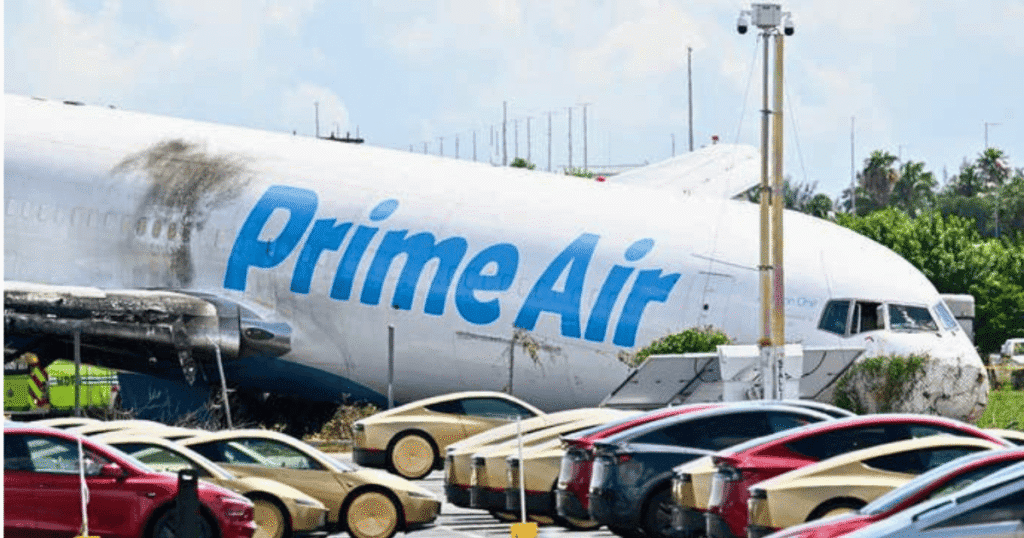
Cockpit audio reveals an Amazon cargo pilot repeatedly warned the aircraft was too fast before a deadly Miami runway crash killed five people.
MIAMI — A pilot aboard an Amazon cargo plane repeatedly warned that the aircraft was traveling too fast during its approach to Miami International Airport, according to newly released cockpit voice recorder information from federal investigators.
The National Transportation Safety Board said one of the pilots raised concerns about the aircraft’s excessive speed for nearly two minutes before and after the Boeing 767 touched down. The warnings came shortly before the plane overran the runway and crashed into vehicles, killing five people and injuring five others.
The aircraft, operated by 21 Air under contract for Amazon, ultimately traveled about 1,300 feet beyond the end of the runway.
Pilot repeatedly warned of excessive speed
According to the NTSB’s review of the cockpit voice recording, one pilot repeatedly commented on the aircraft’s speed as the plane approached the runway.
The other pilot did not provide a consistent verbal response to those warnings, investigators said.
The aircraft was also experiencing an unstable approach. Automated cockpit alerts included repeated warnings about the plane’s descent rate and terrain clearance.
At one point, the aircraft descended about 400 feet in only four seconds, according to information released by investigators. The cockpit warning system issued two “sink rate” alerts followed by five “too low terrain” warnings.
Despite those warnings, the crew continued toward the runway rather than abandoning the landing earlier.
Last-second go-around attempt
The NTSB said one of the pilots called for an aborted landing roughly 15 seconds after touchdown.
The aircraft’s throttles were then advanced to a setting consistent with go-around power, suggesting the crew attempted to get the Boeing 767 back into the air.
However, the attempt came extremely late.
The aircraft was nearing the end of the runway and was still traveling at roughly 120 knots, or about 138 mph, according to flight-data information cited by Reuters. Four seconds after the throttles were increased, they were reduced to idle power.
The plane subsequently left the paved runway surface and continued into the area beyond the airport.
Five people killed in runway overrun
The Amazon cargo jet crashed after overrunning the Miami runway and striking two vehicles on the ground.
Five people inside a van were killed. Another vehicle was also struck as the aircraft continued beyond the runway before coming to a stop.
The two pilots survived the crash.
The incident has prompted investigators to examine why the crew continued an unstable approach despite repeated cockpit warnings and why the go-around attempt occurred only after the aircraft had already landed.
Braking systems raise new questions
Investigators have also found that two systems designed to help slow the aircraft were not deployed during the landing.
The NTSB said there was no indication in the flight data that the Boeing 767’s speed brakes or thrust reversers were activated. Wheel brakes were applied, but they were later released as the throttles were increased for the attempted go-around.
The reasons those systems were not deployed remain under investigation.
Aviation safety experts have pointed to the unstable approach and the failure to initiate an earlier go-around as important areas for investigators to examine.
NTSB continues Miami cargo crash investigation
The fatal crash occurred after the Amazon Air flight arrived in Miami from San Juan, Puerto Rico. The 32-year-old Boeing 767 was operated by 21 Air.
Investigators are examining the cockpit recordings, flight-data recorder information, weather conditions, aircraft performance and crew decision-making as they work to determine what led to the runway overrun.
The NTSB has not yet issued a final determination of probable cause.
The newly released cockpit information, however, provides a clearer picture of the final moments: a pilot recognized that the aircraft was moving too fast, automated systems issued multiple warnings, and a last-second attempt was made to abort the landing.
The investigation will now focus on why those warnings did not lead to an earlier decision to go around — and whether other factors contributed to the deadly crash.
Also read: Felon Arrested at Ilhan Omar’s Son’s Home