
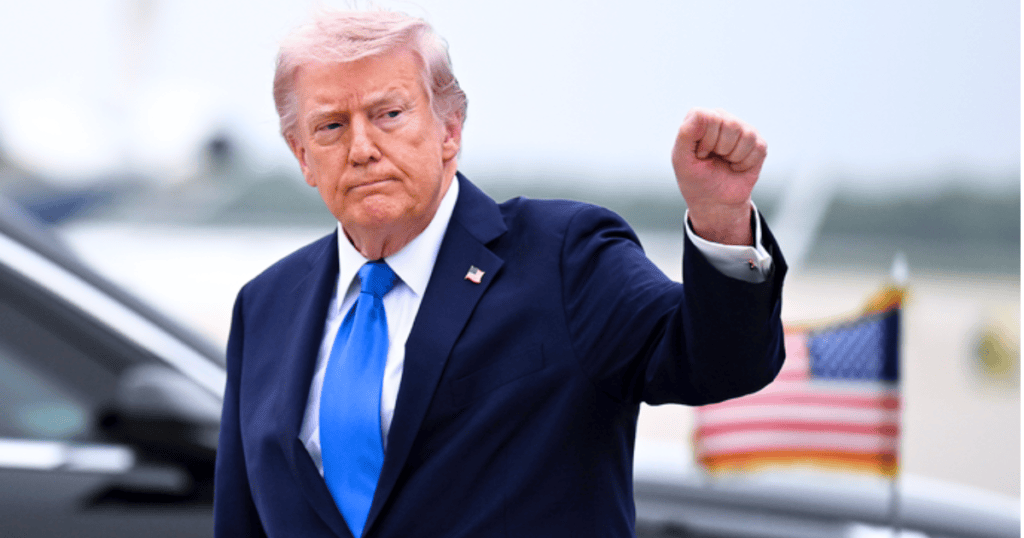
Trump went undefeated in 2026 GOP Senate primaries as Democrats faced a leftward surge, setting up a high-stakes midterm battle in November.
President Donald Trump has strengthened his grip on the Republican Party after going undefeated in GOP Senate primaries during the 2026 election cycle, while Democrats head into the general election facing a growing ideological divide.
The contrasting primary results highlight two very different political dynamics heading into November. Trump-backed candidates have largely prevailed in Republican Senate contests, while progressive and Democratic Socialist-backed candidates have scored major victories against establishment Democrats.
Trump remains a powerful GOP kingmaker
Trump’s influence over Republican primary voters remains one of the defining features of the 2026 midterm cycle.
According to the Fox News Trump Primary Endorsement Tracker, the president posted a perfect record in Senate Republican primaries. His overall record in House GOP contests has also been close to perfect, reinforcing his continued influence over the party’s nomination process.
Trump’s influence has extended beyond simply endorsing candidates. Several Republican primary contests have tested whether candidates aligned with the traditional GOP establishment could survive against contenders backed by the president and his MAGA movement.
One of the most prominent examples came in Louisiana, where Trump-backed candidates defeated Sen. Bill Cassidy, a Republican who had voted to convict Trump during his impeachment trial.
Trump’s record has not been flawless across every type of race. Five of his endorsed gubernatorial candidates lost Republican primaries this year, showing that presidential backing does not guarantee victory in every contest. Still, Republican strategists say the president’s endorsement provides a significant advantage in GOP nomination battles.
Democrats face a different kind of primary revolt
While Republicans have largely rallied around Trump’s influence, Democratic primaries have exposed an increasingly visible struggle between the party establishment and its progressive wing.
Candidates backed by the Democratic Socialists of America and other progressive groups scored several significant victories during the primary season. Among them were Abdul El-Sayed in Michigan, Lt. Gov. Peggy Flanagan in Minnesota and state Rep. Angie Nixon in Florida.
The victories followed earlier primary upsets in which progressive candidates defeated longtime Democratic incumbents.
The results have fueled debate over whether the Democratic Party is moving further to the left and whether that shift will help or hurt Democrats in competitive statewide races.
Michigan race shows the Democratic divide
Michigan has become one of the clearest examples of the Democratic Party’s ideological struggle.
Abdul El-Sayed emerged as the Democratic Senate nominee after defeating Rep. Haley Stevens in the primary. His victory was significant because Stevens had been backed by parts of the Democratic establishment, while El-Sayed built a campaign around a more progressive message.
El-Sayed’s platform reflects several issues that have become increasingly important among the party’s left flank, including opposition to some federal immigration policies, reduced military support for Israel and expanded government-backed health care.
The Michigan contest therefore became more than a routine Senate primary. It was also viewed as a test of which direction Democratic voters want their party to take heading into the next election cycle.
New Hampshire offers another test
New Hampshire’s Democratic Senate primary also underscored the tension between establishment Democrats and progressive challengers.
Rep. Chris Pappas faced a challenge from socialist-aligned candidate Karishma Manzur, who argued that Democrats need a more populist message.
Pappas, meanwhile, presented himself as a pragmatic Democrat capable of appealing to voters across the political spectrum. The contest illustrated the broader question facing Democrats: whether candidates should prioritize progressive activists or concentrate on persuading moderate and independent voters in competitive states.
November will test both strategies
The primary results do not necessarily predict the November outcome.
Trump’s ability to shape Republican nominations gives the GOP a more unified ideological identity, but Republicans still face traditional midterm challenges. The party in power typically faces political headwinds, while economic concerns and Trump’s approval ratings could influence voters in competitive states.
Democrats, meanwhile, enter the general election with several candidates who have emerged from increasingly progressive primaries.
That could energize the Democratic base, but Republicans are likely to argue that some of the nominees are too far to the left for swing-state voters.
Senate control hangs in the balance
The stakes are particularly high because several competitive Senate races could determine which party controls the chamber.
Republicans have successfully navigated their primary season with Trump’s influence firmly established. Democrats have demonstrated that their progressive wing has considerable strength among primary voters.
The question now is whether either strategy can translate into victories in November.
For Trump, the undefeated Senate primary record represents another sign that his influence over the GOP remains remarkably strong. For Democrats, the victories by progressive candidates may signal a broader transformation of the party.
With the primary season now complete, both parties face the same challenge: turning energized primary voters into a coalition large enough to win the general election.
The battle over the Senate is moving into its final phase, and the contrasting primary results suggest that Trump’s Republican Party and an increasingly progressive Democratic Party are heading toward a sharply contested November showdown.


