Former Pentagon official warns Houthis are in a US “kill box” after seizing Perim Island, a strategic chokepoint in the Red Sea.
Iran-backed Houthi rebels have seized the strategically important Perim Island in the Bab el-Mandeb Strait, prompting a former Pentagon official to warn that the militants may have placed themselves in a U.S. military “kill box.”
The Houthis captured the island, also known as Mayun, on September 11 after advancing along Yemen’s western coast. The takeover gives the Iran-backed group a position near one of the world’s most important maritime chokepoints, where the Red Sea meets the Gulf of Aden.
Former Pentagon press secretary and retired Navy Capt. Morgan Murphy told Fox News Digital that the Houthis gained a strategically valuable position but simultaneously exposed their forces to overwhelming American firepower.
“With Perim, they have gained what we could call the cork in the Red Sea bottle,” Murphy said, while warning that the group had also put itself in a “kill box.”
Why Perim Island matters
Perim sits in the Bab el-Mandeb Strait, a narrow maritime passage that serves as a gateway between the Red Sea and the Gulf of Aden. Murphy noted that the waterway is only about 18 miles wide at the point where the island sits.
Control of Perim could give the Houthis an important vantage point over commercial shipping moving through the Red Sea, potentially increasing pressure on one of the world’s most heavily used trade routes.
The island is also located roughly 20 miles off the Horn of Africa and is relatively close to Camp Lemonnier in Djibouti, a major U.S. military installation.
Murphy argued that the island’s geography could make it difficult for the Houthis to defend if the United States decided to use military force.
Former Pentagon official warns Houthis exposed
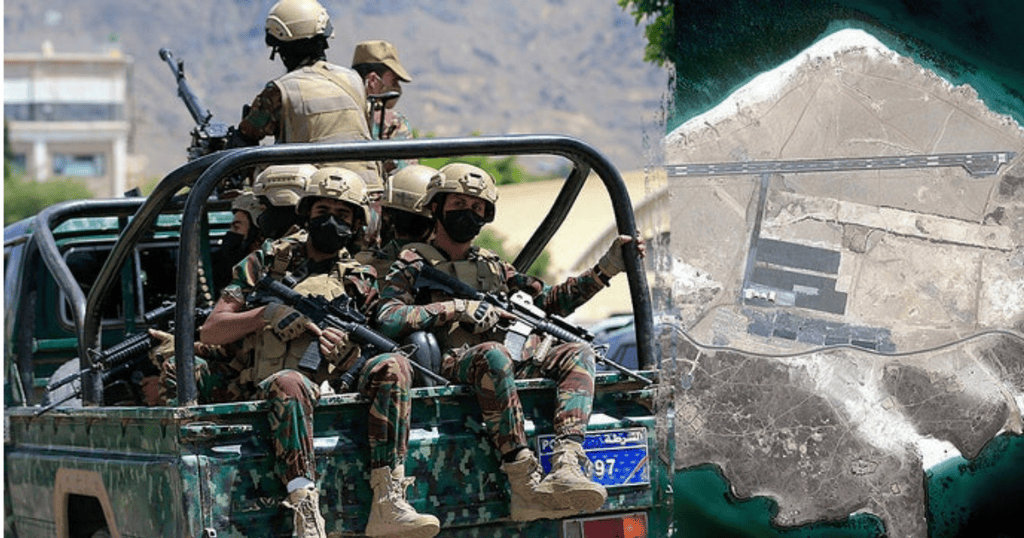
Perim is a largely barren volcanic island with limited natural resources. Satellite imagery shows a roughly 6,000-foot runway and three military hangars on the island, although the condition and potential military usefulness of the airstrip remain uncertain.
Murphy said the Houthis lack the sophisticated airpower and military capabilities needed to effectively defend the island against the United States and its allies.
He described the concentration of Houthi forces on the isolated island as the kind of battlefield situation the U.S. Navy could exploit if Washington ordered an attack.
The warning comes as the Houthis continue to expand their presence along Yemen’s western coast amid a broader conflict involving Iran, Saudi Arabia and Yemen’s internationally recognized government.
Trump has resisted direct intervention
The Houthi advance comes amid calls for stronger U.S. action against the Iran-backed group.
According to Fox News Digital, Saudi Crown Prince Mohammed bin Salman called President Donald Trump twice on September 10 and urged him to authorize U.S. military strikes against Houthi positions. Trump declined to order direct intervention, with U.S. officials saying the administration currently has no immediate plans for direct combat involvement while continuing to provide intelligence assistance.
Trump has also said the Houthis contacted the United States and indicated they did not want a direct confrontation with American forces.
“We’re in a different era,” Murphy said, arguing that the Houthis are operating with significantly less sophisticated military capabilities than the United States and other major powers.
Iran’s role raises wider concerns
The Houthi seizure of Perim has also raised concerns about Iran’s role in the group’s expanding military capabilities.
Yemeni, regional and Iranian sources cited by Reuters said the Houthi advance was supported by Iranian weapons and tactical direction from Iran’s Islamic Revolutionary Guard Corps. U.S. officials estimate that hundreds of IRGC personnel remain active in Yemen, according to the report cited by Fox News.
The strategic objective could extend beyond Yemen’s civil war. Murphy suggested Iran could benefit from disrupting major shipping lanes and pushing global energy prices higher.
Perim’s position gives the Houthis a potential pressure point near a critical international shipping route, although how effectively the group can use the island remains uncertain.
For now, the capture represents a major strategic development in the Red Sea region. The Houthis have gained control of a key piece of territory, but the same position could leave their forces highly exposed if the United States decides to respond militarily.
Also read: Ancient Pilate Ring Offers New Clues on Jesus’ Crucifixion