
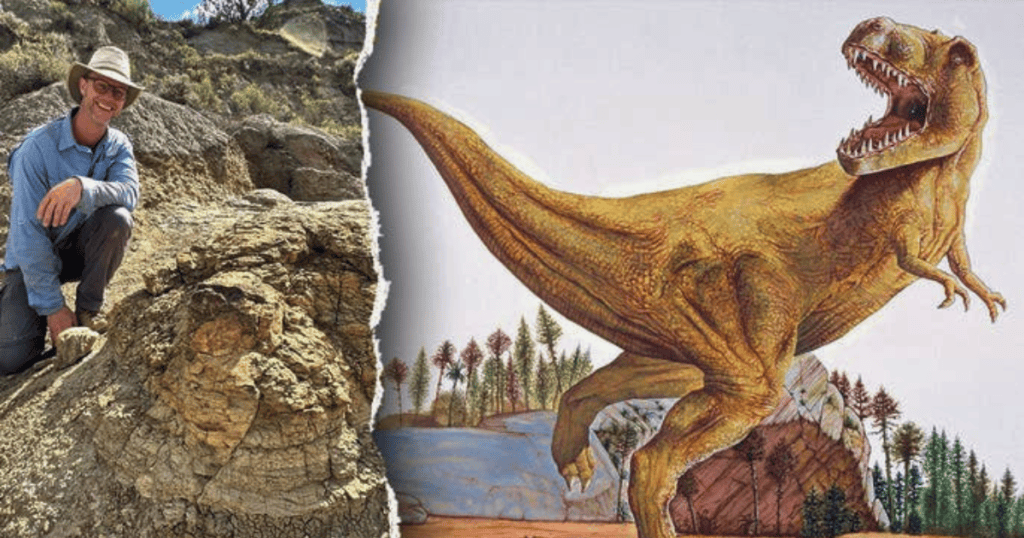
Scientists found the first known adult T. rex trackway in North Dakota, revealing how the giant predator walked 66.5 million years ago.
Scientists have uncovered what researchers believe is the first known trackway left by an adult Tyrannosaurus rex, offering an unusually detailed glimpse into how the iconic dinosaur moved across the landscape more than 66 million years ago.
The remarkable fossil trail was discovered in southwestern North Dakota’s Hell Creek Formation and consists of four enormous three-toed footprints. Researchers estimate the tracks date to approximately 66.5 million years ago, near the end of the Cretaceous Period.
Unlike isolated dinosaur footprints, the connected sequence provides evidence of movement rather than simply showing where an animal once stood.
Four giant footprints preserve a rare trail
The trackway stretches approximately 23 feet, or about 7 meters, across the ancient landscape.
Each footprint measures roughly 3 feet long, with two tracks belonging to the left foot and two to the right. The spacing between the prints indicates a stride of approximately 13 feet.
Scientists identified an adult T. rex as the most likely animal responsible for the tracks based on their exceptional size and narrow, three-toed shape, as well as the abundance of T. rex fossils found in the surrounding region.
Although individual footprints have previously been attributed to adult T. rex, researchers say this is the first described sequence of tracks likely produced by an adult of the species.
The tracks reveal how T. rex walked
Perhaps the most intriguing detail is what the footprints suggest about the dinosaur’s pace.
Researchers estimate the T. rex was moving at approximately 3.5 to 4.5 mph. That is roughly comparable to a brisk human walking speed rather than a high-speed chase. Scientists caution that the estimate is approximate because the tracks have been heavily weathered.
The discovery therefore gives paleontologists something bones alone cannot provide: a physical record of an individual dinosaur moving through its environment.
“Trackways” are particularly valuable because they preserve the relationship between multiple footprints, allowing scientists to examine stride length, direction and estimated speed.
A teacher helped uncover the discovery
The fossil trail was discovered in 2025 on federal land administered by the U.S. Forest Service near Marmarth, North Dakota.
Kent M. Hups, a teacher at Northglenn High School in Colorado, discovered the locality while participating in fossil fieldwork. He later became a co-author of the scientific paper describing the tracks.
The research team included scientists from the Denver Museum of Nature & Science and Liverpool John Moores University.
The discovery also highlights how important careful observation remains in paleontology. A single unusual impression in the rock ultimately led researchers to identify a much larger sequence of footprints.
Scientists created detailed 3D models
Researchers used high-resolution 3D surface scanning to document the footprints and the entire trackway.
The digital models allow scientists to examine the tracks in detail without repeatedly returning to the remote fossil site. They can also be used to produce physical reproductions for research and educational purposes.
Peter Falkingham, a paleobiology professor at Liverpool John Moores University and the study’s lead author, was able to analyze digital versions of the footprints remotely using computer visualization and virtual reality.
The approach demonstrates how modern technology is changing the study of fossils that are difficult to access or transport.
Parts of the fossil trail will be moved to Denver
Three of the footprints are expected to be recovered from the site by helicopter this fall and transported to the Denver Museum of Nature & Science for preparation and additional research.
The museum plans to provide updates about the recovery and eventually share the specimens with the public.
The scientific findings were published in the Journal of Vertebrate Paleontology in a study describing the large trackway from the Upper Cretaceous Hell Creek Formation.
For researchers, the significance of the discovery extends beyond four giant footprints. The trail preserves a fleeting moment from the life of one of Earth’s most famous predators, showing not just that an adult T. rex existed in the area, but how it moved through the environment shortly before the dinosaurs disappeared.
Also read: Common Antibiotic Tied to Higher Death Risk


