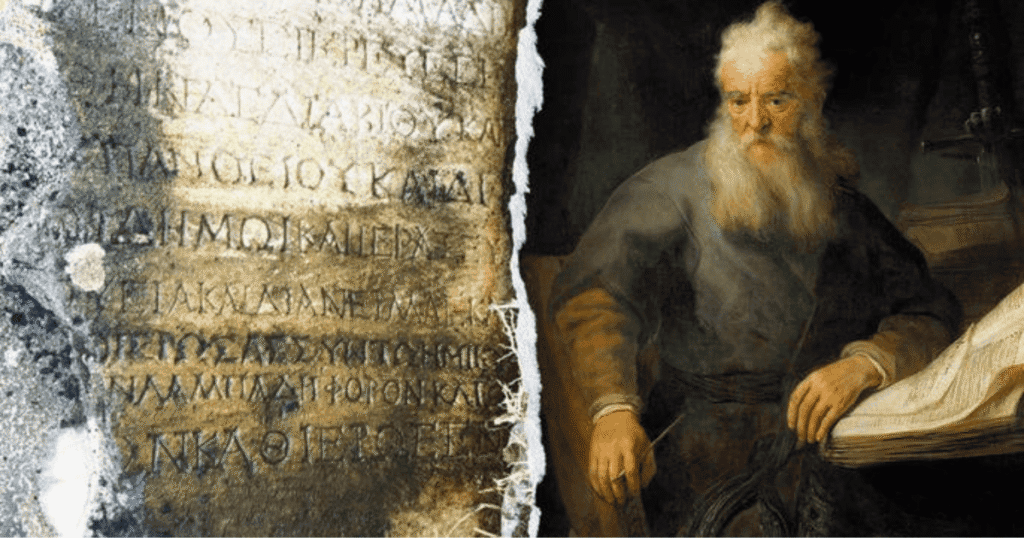
Ancient inscriptions and archaeological evidence shed new light on the diverse religious world Apostle Paul encountered during his missionary journeys.
TURKEY — More than 2,000 years ago, the regions visited by the Apostle Paul were home to a complex mix of religious traditions, civic cults and competing ideas about the divine.
Ancient inscriptions discovered across what is now Turkey and the wider eastern Mediterranean are helping archaeologists and historians reconstruct that world — providing a glimpse into the religious environment in which Paul preached Christianity to Jewish and Gentile communities.
The evidence does not simply document the arrival of Christianity. It shows the religious landscape that existed before and alongside the growth of the early Christian movement, when temples, local gods, imperial worship and Jewish communities were part of everyday life.
Archaeological evidence from the period can help put Paul’s writings and missionary journeys into a broader historical context.
Inscriptions reveal a religiously diverse world
The ancient Mediterranean was not dominated by a single religious tradition.
Cities throughout Asia Minor contained temples, shrines and inscriptions dedicated to different deities, while Roman political authority increasingly became intertwined with religious practice.
At Sardis, for example, archaeological evidence includes inscriptions associated with the imperial cult and religious officials connected with the worship of the Roman emperors. Researchers say such evidence illustrates the continuing importance of religious institutions in Roman civic life.
For Paul, this was the environment in which his message about Jesus Christ encountered established religious traditions.
Paul preached in the heart of Asia Minor
Paul’s missionary journeys took him through numerous cities in Asia Minor, including locations in modern-day Turkey.
The Book of Acts describes Paul visiting synagogues and speaking with both Jewish audiences and Gentiles. Archaeological discoveries have provided independent evidence for some of the social and religious groups mentioned in accounts of his travels.
One notable example comes from Aphrodisias in southern Turkey, where archaeologists discovered inscriptions referring to “Godfearers” — Gentiles associated with Jewish religious communities. The discovery helped provide archaeological context for references in Acts to Gentiles who participated in synagogue communities.
The inscriptions therefore offer a window into the complicated religious boundaries Paul encountered.
Roman emperor worship added another layer
Religion in the Roman world was closely connected to political life.
The cult of the emperor could appear alongside traditional local religious practices, with cities honoring Roman rulers through temples, inscriptions and public ceremonies.
At Priene, in modern Turkey, an ancient inscription celebrates Emperor Augustus and describes his birth in religiously charged terms. The inscription is one example of how political authority and divine language could overlap in the Roman world.
Such practices created a very different religious environment from the emerging Christian communities associated with Paul.
The Delphi inscription helps date Paul’s ministry
One of the best-known inscriptions connected indirectly to Paul’s historical setting was discovered at Delphi in Greece.
Known as the Gallio inscription, the text records a letter from Emperor Claudius concerning Delphi and identifies Gallio as the Roman proconsul of Achaea.
The Book of Acts identifies Gallio as the official before whom Paul appeared during his time in Corinth. Because the inscription helps establish Gallio’s tenure around A.D. 52, historians have used it as an important chronological marker for Paul’s missionary activity.
The discovery demonstrates how inscriptions can help historians connect archaeological evidence with events described in early Christian writings.
Ancient cults did not disappear overnight
The emergence of Christianity did not immediately erase older religious traditions.
Instead, different belief systems existed alongside one another for generations. Temples, civic rituals, Jewish communities and emerging Christian groups could all form part of the religious landscape of the eastern Roman Empire.
Modern archaeological research continues to uncover inscriptions that reveal how people identified their gods, honored political leaders, participated in religious associations and commemorated important individuals.
That evidence is especially valuable because inscriptions can preserve ordinary aspects of ancient religious life that literary sources sometimes overlook.
What the discoveries tell us about Paul’s message
Paul’s message entered a world that was already filled with religious ideas and institutions.
His audiences were not encountering the concept of divine worship for the first time. Instead, Paul’s preaching presented a particular claim about Jesus within a society where people already understood temples, sacrifices, gods, religious associations and divine rulers.
That context helps explain why Paul’s missionary work, recorded in Acts and reflected in his letters, repeatedly involved debates over idols, Jewish law and the relationship between Jewish and Gentile believers.
Archaeological evidence cannot answer every question about Paul’s ministry, but it can illuminate the environment in which that ministry unfolded.
More than 2,000 years later, ancient inscriptions continue to provide historians with pieces of that world — revealing the religiously diverse societies through which Paul traveled and showing just how dramatically the early Christian message entered an already crowded spiritual landscape.
Also read: Top 10 Charlie Kirk moments remembered one year later