
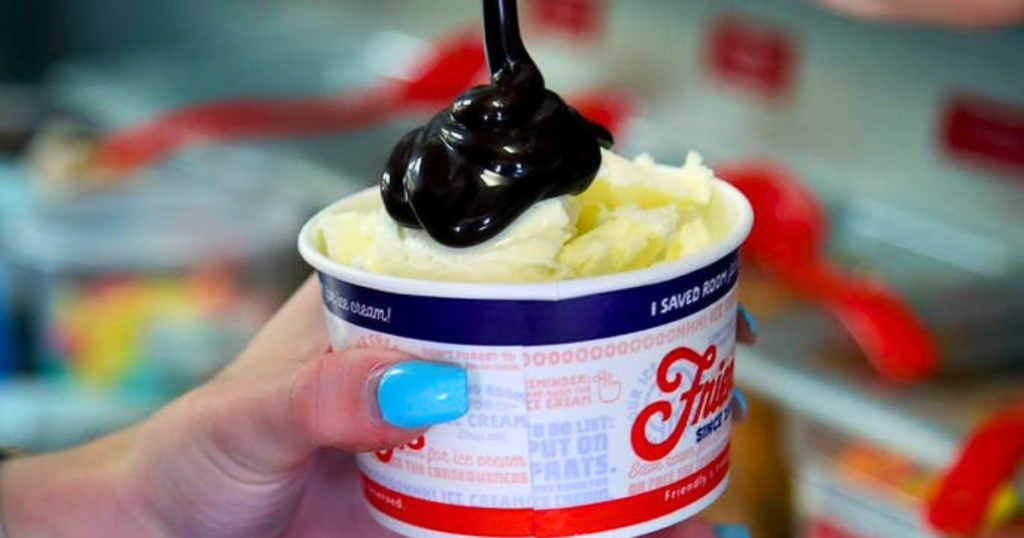
Friendly’s has fallen from 850 restaurants to just 87 across 11 states. Here’s how the iconic ice cream chain reached this point.
For generations of Americans, a trip to Friendly’s meant burgers, ice cream sundaes and a casual family meal. But the once-expansive restaurant chain has become a much smaller presence on the American dining scene.
Friendly’s, the nostalgic restaurant brand that once operated approximately 850 locations, now has just 87 restaurants across 11 Eastern states, according to reporting cited by Fox News. The dramatic decline reflects decades of ownership changes, financial struggles and shifting consumer preferences.
Despite its shrinking footprint, the chain is not disappearing entirely. One marketing expert believes its longstanding brand recognition and nostalgic appeal could still give it room to rebuild.
For longtime customers, however, the numbers highlight just how much the familiar restaurant landscape has changed.
Friendly’s Has Lost Nearly 90% of Its Locations
Friendly’s has experienced a steep decline from its peak of approximately 850 restaurants in the mid-1990s.
Today, the chain operates just 87 locations, meaning roughly 90% of its former restaurant footprint has disappeared.
The remaining locations are concentrated in the eastern United States, with Massachusetts accounting for 22 restaurants — about one-quarter of the total.
That regional concentration reflects Friendly’s deep roots in New England, where the brand built its reputation as a neighborhood destination for families, burgers and ice cream.
For customers who grew up visiting Friendly’s, finding a nearby location has become increasingly difficult as restaurants have closed over the years.
From a Small Ice Cream Shop to a Regional Favorite
Friendly’s began in 1935, when brothers Prestley and Curtis Blake opened an ice cream shop in Springfield, Massachusetts.
The business started with an affordable treat: double-dip ice cream cones sold for just five cents.
The brothers expanded into food in 1940, adding hamburgers and turning the shop into more of a dining destination.
The concept caught on. By 1951, Friendly’s had 10 restaurants in Massachusetts and Connecticut. By 1974, the company had grown to 500 locations throughout the Northeast and Mid-Atlantic.
Its combination of casual meals and ice cream desserts helped establish Friendly’s as a recognizable family restaurant brand.
The company also expanded its reach through supermarket ice cream sales, allowing customers to enjoy its products even when a restaurant wasn’t nearby.
Friendly’s marked its 90th anniversary in 2025, a milestone that underscores the brand’s long history in American dining.
Bankruptcy and Ownership Changes Reshaped the Chain
Friendly’s expansion was followed by years of financial and operational challenges.
The Hershey Company acquired the restaurant chain in 1979 before selling it to Tennessee Restaurant Company in 1988.
Friendly’s later filed for bankruptcy in 2011 and again in November 2020.
The second bankruptcy came during a difficult period for the restaurant industry, as COVID-19 restrictions disrupted dine-in operations and businesses faced rising costs and changing customer habits.
In 2021, Amici Partners Group acquired Friendly’s, with plans to reinvigorate the restaurant business.
But ownership changes alone have not restored the chain to its former size.
The decline reflects the challenges facing established casual-dining brands as they compete for customers while managing operating expenses, changing demographics and evolving dining preferences.
Why Friendly’s Struggled to Keep Up
Friendly’s built its identity around a family-friendly atmosphere, affordable meals and memorable ice cream desserts.
However, maintaining that appeal across generations has become increasingly difficult.
Barbara E. Kahn, a marketing professor at the University of Pennsylvania’s Wharton School, told Fox News Digital that some Friendly’s restaurants appeared dated and had struggled to keep pace with modern dining trends.
Restaurant customers now have a broad range of choices, from fast-casual chains to delivery-focused businesses and newer dining concepts.
For an older brand, maintaining customer loyalty may require more than relying on familiar menu items and memories.
Rising costs and competition have also placed pressure on traditional sit-down restaurants, particularly those that need to maintain larger dining spaces and substantial staffing levels.
Friendly’s experience illustrates the difficulty of preserving a legacy restaurant brand while adapting to a rapidly changing marketplace.
Can Nostalgia Help Friendly’s Make a Comeback?
Despite the chain’s contraction, Kahn believes Friendly’s still has an opportunity to reconnect with customers.
She pointed to the brand’s nostalgic appeal and its established association with family dining and ice cream as assets that could support a revival.
For customers who remember visiting Friendly’s as children, the brand may carry emotional value that newer restaurant concepts cannot easily replicate.
But nostalgia alone may not be enough.
Kahn suggested that Friendly’s could benefit from updating its offerings to reflect changing consumer tastes, potentially including more non-meat options, healthier grains and salads.
That approach would allow the chain to retain its familiar identity while giving newer customers additional reasons to visit.
The challenge is finding the right balance between preserving what made Friendly’s recognizable and making the restaurant relevant to today’s diners.
Friendly’s Future Remains an Open Question
Friendly’s shrinking restaurant count reflects a major transformation for a brand that once operated hundreds of locations across the country.
Yet its remaining restaurants, grocery-store ice cream presence and decades of brand recognition mean its story is not necessarily over.
Whether Friendly’s can regain momentum will depend on how effectively it responds to modern dining habits, manages costs and reconnects with customers.
For now, the chain’s 87 remaining locations represent a much smaller version of the restaurant that once served generations of American families.
And for those who still associate Friendly’s with childhood meals and ice cream outings, the brand’s next chapter will be worth watching.
Also read: Warren Buffett Steps Down as Chairman of Berkshire